
Printables
Mould Generator for Thermoforming (Vacuum forming)


- Creator (as listed at the source)
- Thiadmer Riemersma
- Licence
- Creative Commons — Attribution — Share AlikeStated at the source marketplace; SliSearch does not verify licences.
- File types
- SCAD STL
- Pricing
- Free
- Published
- Category
- Tools
- Downloads
- 2
Overview
A mould for thermoformed (vacuum formed) inlays for packaging objects in (small) boxes. While I have added the STL files for the two moulds that I have made so far, these are only useful when you have objects of (almost) the same size that must fit in the same boxes that I have used. The true focus is on the OpenSCAD script that enables you to customize all settings to fit your own objects and boxes. All settings can be modified with the OpenSCAD customizer.
At the moment, it only supports (rounded) rectangular shapes for the object, and only a single object per inlay. Next to the mould for the inlay, this script also generates a frame to help cut out the inlay from the sheet after thermoforming.
Sharp corners or edges cannot be thermoformed. Therefore, you set a radius for the vertical edges and a general rounding for the horizontal edges. The rounding for the vertical edges is set separately for the object and for the outer shape of the mould. Thus, if you set a large radius for the object, you end up with (nearly) round or oblong shapes.
Vertical wall are actually not entirely vertical, because otherwise it becomes impossible to separate the mould from the sheet after thermoforming. The minimum slant is probably 5 degrees. In the script, the slant is expressed as the tangent of the angle, and 0.1 is probably the lowest value you should use.
Read the full description
For the object dimensions, a tolerance should be set, but which depends on the thickness of the sheet that is used for thermoforming.
The air pipes to the recessed pocket the inset for the object are square instead of round. The only reason was an attempt to reduce print time of the mould. However, on my test, it shaved off less that 10%, so it wasn't really worth the trouble. Nevertheless, it does not hurt either, so it stayed.
In thermoforming, a very hot sheet of plastic is pressed onto the mould, time and again. Thus, I would avoid PLA because of its low temperature resistance. ABS or polycarbonate are better choices. I printed my moulds in PETG, and while this appears to work just fine, one caveat is that the transparent thermoforming sheets are also often PET, and PET has a reputation of sticking to nothing apart from PET. In other words, when pressing hot PET sheets over a mould printed in PETG, those tend to stick together. To mitigate this, I add a bit of grease on the surface of a mould (but be carefull to not clog the air pipes with grease).
Print this with Prinnu
- Download the model file from the source page. SliSearch moves no files.
- Upload the file at slicience.com/quote. Prinnu quotes it in minutes.
Similar models
Chosen by shared tags first, then category. Each one links to its own marketplace.
 DIY D20 - Resin Casting KitDIY Mould for making your own D20 Countdown dice (For Magic the Gathering or similar). Kit includes a three-part mould box and D20 model with pouring spout for creating a silicone mould.
 skull mouldi used PLA with 30% infill
 Thermoforming MachineAn easy to use thermoforming machine. The simple belt-system allows upside-down thermoforming like professional machines do it. With a fast-switch frame system small series can be efficient produced.
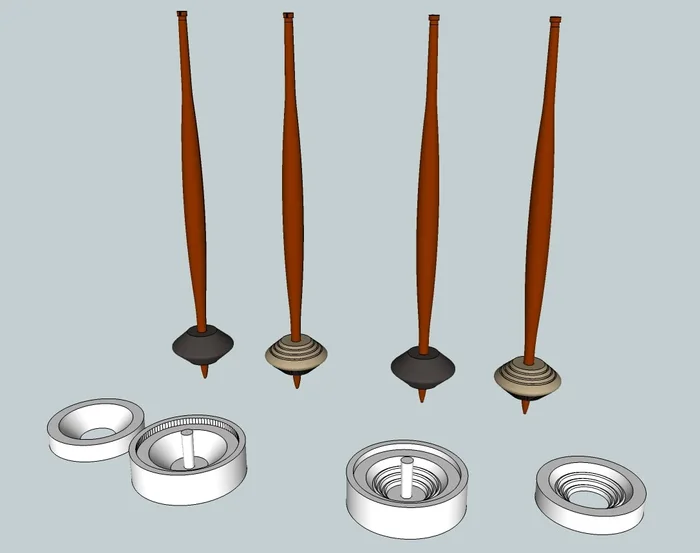 Viking Spindle
 robotic hand servo controlled fingersServo controlled hand. By flexing the elbow the hand will close. The servos are controlled by a servo testing unit, so no need for arduino sketch etc.
 Viking Crucible MoldThis is a simple 3 parts mold to make viking clay crucible to melt small amount of metal. If the clay sticks to the inner part of the mold add a layer of saran wrap to remove it easily.
 Adjustable Mould BoxThis adjustable mould box is able to be between 8.5 square centimetres and 2 square millimetres. To use it, simply print it out (as fast as possible, quality and speed don't really matter), adjust the size, pop on the clips and line the...
 Customizable Gasket Mold MakerThere are a few customizable gasket molds on Thingiverse, but none of them offer the features I was looking for, so I made my own. Hit the Customizer button to make your custom gasket mold.
 Profile copy toolSmall tool to copy shapes and transfer them. The STL is designed for 6 cms wide and 52 blades but it is possible to increase the outer room in the slicer. Youtube link : Petit outil pour copier des formes et les reporter.
 Customizable Flex Joint MoldPrintable mold for flex joints of customizable size, including those for Gyrobot's Flexy-Hand. We are currently experimenting with Smooth-On's "Dragon Skin" silicone but other materials may also be viable.
SliSearch is an index: it stores public metadata only, does not host files, does not verify licences, and has no partnership or affiliation with the indexed marketplaces.